FLAGTAG Golf Push Cart — Walk More, Carry Less

FLAGTAG golf push cart options cover both configurations golfers actually need: a 360° swivel 3-wheel at 16.98 lbs for agility on tight courses, and a 4-wheel rectangular-base model at 17.2 lbs for hilly terrain with a heavy bag. Every cart is full-featured aluminum and includes cup holder, umbrella mount, cooler bag, and golf tray out of the box — not upsold separately. Same one-click fold. Same aluminum alloy frame. You pick based on how you actually play.
✓ Aluminum frame under 17.5 lbs✓ One-click fold in 10–15 seconds✓ Every accessory included
Shop on Amazon
FLAGTAG Golf Push Cart 4-Wheels
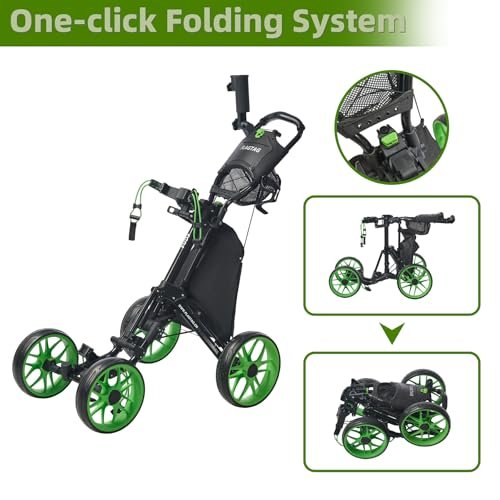
One-Click Fold in 10–15 Seconds Flat

Lift the handle, press the button — both models collapse to trunk-ready size without a wrestling match.

Aluminum Frame, Under 17.5 lbs

The 3-wheel checks in at 16.98 lbs and the 4-wheel at 17.2 lbs — light enough to grab from the trunk with one hand after 18 holes.

Every Accessory Comes Standard

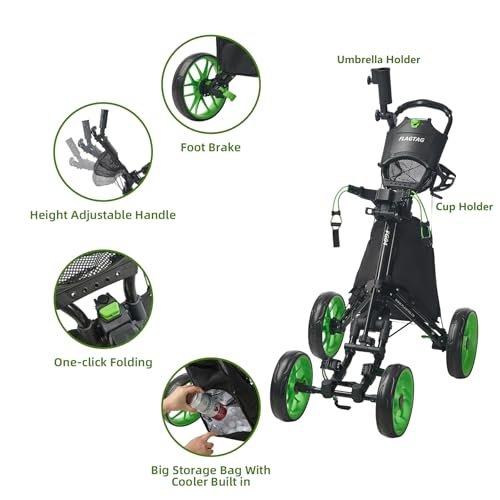
Cup holder, umbrella mount, storage bag with built-in cooler, and golf tray ship with every model — nothing extra to buy.

3-Wheel or 4-Wheel — Your Call

The 360° swivel 3-wheel handles tight turns; the 4-wheel rectangular base stays planted on side slopes — choose based on your course.

FLAGTAG Push Cart Models for Walking Golfers

Three models, two configurations — each built around aluminum alloy frames, one-click folding, and a full accessory kit included at purchase. The differences between them matter, and the cards below lay out exactly who each one is built for.

FLAGTAG Golf Push Cart 3 Wheel with 360 Swivel Front Wheel

3-Wheel 360° Swivel Cart (White)

The lightest fully equipped model in the lineup at 16.98 lbs, with a front wheel that rotates a full 360 degrees — so tight turns on winding cart paths take a nudge, not a muscle. Folds to 16.5 × 20.5 × 28.3 inches and ships with cup holder, umbrella mount, mesh net, and storage bag with cooler standard.

The 360° swivel front wheel is the reason to choose this one — it's built for golfers who navigate sharp bends and tight cart paths every round, not just occasionally.

See on Amazon
FLAGTAG Golf Push Cart 4-Wheels

4-Wheel Folding Cart (Green)

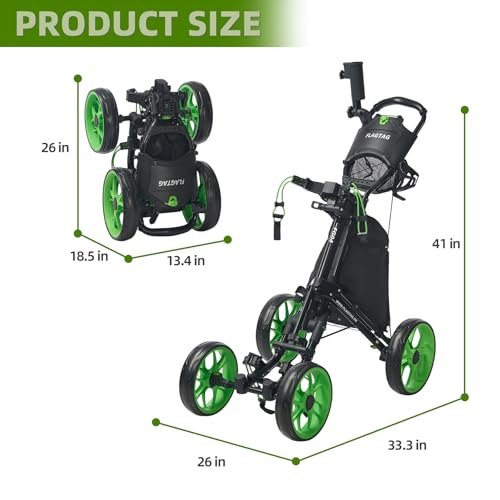
Four wheels sit on a rectangular base that doesn't tip sideways on cross-slope terrain the way a 3-wheel triangle can. At 17.2 lbs with an aluminum alloy frame, it hauls a fully loaded cart bag without flex or wobble. Folds to 28.3 × 18.5 × 17.7 inches. Most reviewed model in the lineup with 225 ratings at 4.4 stars.

If you play hilly courses or carry a heavy bag and need the cart to stay put between shots, this rectangular-base 4-wheel is the model that earns its keep.

See on Amazon
FLAGTAG Golf Push Cart 3 Wheel

3-Wheel Fixed Front Cart (Orange)

The lightest model overall at 16.09 lbs, with 10.5-inch detachable front and rear wheels and a fixed front wheel rather than a swivel. Folds to 30 × 17 × 14.2 inches. The elastic upper bracket strap adjusts to fit different bag sizes, and the full accessory kit — umbrella holder, cup holder, cooler bag, golf tray — comes standard.

For golfers who want to shave every possible pound from their setup and don't need the 360° swivel, this is the lightest cart in the FLAGTAG lineup at 16.09 lbs.

See on Amazon

Which FLAGTAG Cart Fits Your Game

The 3-wheel with 360° swivel handles tight, winding courses better. The 4-wheel handles hills and heavy bags better. Those two sentences cover 90% of the decision — but here's the detail behind each one so you can pick with confidence rather than guessing.

FLAGTAG Golf Push Cart 4-Wheels

Pick the 3-Wheel 360° Swivel if any of these sound like you

Your course has narrow cart paths that bend and double back. You push your cart across the green side, then need to redirect quickly to the next tee. You've watched a 4-wheel cart require a three-point turn in a tight space and decided that's not for you.

The 360° swivel front wheel on the white 3-Wheel 360° Swivel Cart (B0FG2VPJCZ) rotates a full rotation — which means the cart changes direction when you change direction, not half a second later. Sharp left? The cart follows. U-turn through a narrow opening? Done without lifting or muscling the handle sideways. On relatively flat or gently rolling terrain, this is the more natural, less-effort option for most golfers.

It also comes in at 16.98 lbs — the lightest cart in the FLAGTAG lineup that still includes the full accessory set. If you're making 36 to 54 round trips to the trunk this season, that difference is real by October.

One honest trade-off: on significant side-slope terrain — where the ground falls away to one side of the cart — a triangular three-wheel base can feel less planted than a four-wheel rectangle. The foot brake handles stationary parking, but the physics of a triangle versus a rectangle on a crosshill lie don't change.

Pick the 4-Wheel Folding Cart if this matches your situation

You play a hilly layout. Or you carry a heavier cart bag — the kind that's loaded with 14 clubs, several sleeves of balls, rain gear, and a jacket. Or you've had a 3-wheel cart drift sideways on you while you were mid-swing and you'd rather not repeat that.

The green 4-Wheel Folding Cart (B0DLRR2DRQ) sits on a rectangular four-point footprint. That wider base is measurably more resistant to tipping on side slopes than a triangular footprint — it's simple geometry, and it matters on courses where fairways rarely sit level. At 17.2 lbs with that rectangular base and all accessories included, it's only 0.22 lbs heavier than the swivel model. You're not giving up much in the parking lot to get that extra stability on the course.

Steering the 4-wheel requires a slightly different approach. Instead of a swivel that follows you, you're pivoting the cart on its rear wheels through turns. On open courses with wide paths, you'll never notice. On a tight, winding municipal layout, you might wish for the swivel.

This is also the most-reviewed FLAGTAG model — 225 ratings at 4.4 stars. That's the widest sample in the lineup, which matters when you're evaluating a brand you haven't bought before.

Pick the 3-Wheel Fixed Front Cart if weight is your only priority

The orange 3-Wheel Fixed Front Cart (B0DNMNBZDG) is the lightest cart in the lineup at 16.09 lbs — nearly a pound lighter than the swivel model. It has a detachable fixed front wheel rather than a swivel, 10.5-inch front and rear wheels, and folds to 30 × 17 × 14.2 inches.

It's the right call for a golfer who walks flat or gently rolling terrain, doesn't need the turning agility of the swivel, and wants to keep total cart weight as low as possible. It's the entry point of the FLAGTAG lineup in terms of complexity — fewer moving parts in the steering, same aluminum frame, same foot brake.

What it gives up relative to the swivel model: navigating tight cart path turns takes more effort, since you're steering a fixed front wheel rather than letting the swivel do the work.

The short version

  • Tight, winding course / flat to rolling terrain: 3-Wheel 360° Swivel Cart (White)
  • Hilly terrain / heavy bag / stability priority: 4-Wheel Folding Cart (Green)
  • Minimum weight / simple design / flat course: 3-Wheel Fixed Front Cart (Orange)

None of these is the wrong answer. They're just answers to different questions about how you actually play.

How the Foot Brake Performs on Hills

Tap the pedal once to lock the rear wheel. Tap it again to release. That's the entire operation — no lever to reach for, no handle to let go of while the cart is still moving. On any slope where the cart would otherwise roll away from you between shots, this is what keeps it in place.

What the foot brake actually does

The foot brake on all three FLAGTAG models engages a physical lock on one of the rear wheels. When it's down, the wheel doesn't rotate. The cart stays where you left it — on a slope, on a green-side bank, on a cart path that tilts toward the rough. You walk up to your ball, make your swing, come back, tap the pedal to release, and push on.

FLAGTAG Golf Push Cart 4-Wheels

The pedal is positioned so you engage it without letting go of the push handle. That matters on a hill: you're not trying to hold the cart in place with one hand while bending down to fiddle with a lever. Tap down with your foot, hands-free, done.

Where it earns its keep

The 90-degree cart rule covers most situations where you'd want this feature. On courses that enforce 90 degrees — carts stay on the path until you're even with the ball, then drive straight out — you're often parking on a cart path that runs slightly downhill or across a slope. Without a brake, that cart is moving while you're walking 15 yards away to your ball. With the brake, it stays put.

Same logic applies when you stop to chip from just off the green. You set the cart down, you walk to your ball, and you need to know the cart isn't going to slowly roll into a bunker while you're concentrating on your shot. The foot brake gives you that without any drama.

What the foot brake doesn't do

Honest answer: it's a single-wheel lock, not a parking brake system that grips both rear wheels simultaneously. On moderate slopes, one locked rear wheel is more than enough to hold the cart. On genuinely steep terrain — think a severe downhill lie on a course with aggressive elevation changes — a single-wheel lock may allow some lateral drift, depending on the surface and bag weight.

For the 3-wheel triangular base in particular, understand that the foot brake holds the cart from rolling forward or backward. It doesn't change the geometry of a triangular footprint on a significant side slope. If you're playing a course where fairways consistently tilt hard to one side, the 4-wheel's rectangular base gives you more passive stability between shots — the brake is doing less of the work on its own.

That's not a flaw in the brake design. It's just physics. The brake is excellent at what brakes do. It won't substitute for four contact points when four contact points are what the terrain calls for.

How to use it in practice

Most walking golfers develop a habit quickly: every time you stop and step away from the cart, your foot taps the pedal. You don't think about it after the first few holes. On flat terrain you'll barely use it. On a course with any real elevation change, you'll use it on almost every shot. Either way, the motion is fast enough that it stops feeling like a step and starts feeling like part of putting the cart down.

What Walking Golfers Say About FLAGTAG

FLAGTAG holds a 4.4-star average across all three models and 488 total reviews on Amazon. That's a meaningful sample for a brand that hasn't yet appeared in the major editorial roundups. Here's what the pattern looks like — what reviewers consistently get right, where they note trade-offs, and who probably shouldn't buy this cart.

What reviewers get right about it

Assembly is the first thing people mention. Specifically: you snap the three wheels onto the axles. No tools, no instructions required, no forty-minute frustration session in the garage. Multiple Amazon reviewers call it out as a genuine strength, not just a checked box. For the 4-wheel model, the process is equally direct — the frame unfolds and the wheels are already attached.

The fold mechanism gets consistent validation too. Lift the handle, press the button — the cart collapses in 10 to 15 seconds. People who've owned poorly designed folding carts appreciate this. There's a specific frustration in standing at your trunk after 18 holes trying to coax a cart into folding, and reviewers who've experienced that frustration on other brands note that FLAGTAG doesn't ask for it.

FLAGTAG Golf Push Cart 4-Wheels

The weight gets mentioned favorably in context. At 16.98 lbs (3-wheel swivel) and 17.2 lbs (4-wheel), these aren't the lightest carts on the market — brands like KVV go lighter, but with a substantially stripped-down accessory set. For what you're getting out of the box, the weight feels appropriate, and reviewers say so. The comparison that keeps coming up organically in community discussions is value relative to established brands — the Facebook observation that the cart is "half the price of a Bag Boy" reflects how buyers in this category are already framing it.

Where reviewers note the trade-offs

The accessories — cup holder, umbrella mount, mesh net — are functional and included, which is the right way to think about them. They're not built to the same standard as the aluminum frame itself. The frame is the structural workhorse; the accessories serve their purpose without being overbuilt. A few reviewers have noted that the umbrella mount or cup holder requires some positioning to feel fully secure. None of this is unusual in this price tier — it's the honest version of "included accessories on a value-positioned cart."

The cooler compartment in the storage bag keeps drinks cold for a round on a moderate-temperature day. It's not a Yeti. A couple of cans or a water bottle, kept cool for 18 holes in reasonable weather — that's the realistic use case. Don't expect more than that and you won't be disappointed.

For the 3-wheel models, a handful of reviewers on hilly courses note what the spec differences would already suggest: the triangular wheelbase handles flat and rolling terrain well, but on significant side-slope terrain with a heavy bag, the 4-wheel's rectangular base earns its existence. This isn't a quality issue — it's a configuration issue, and it's exactly why FLAGTAG offers both.

Who this cart is NOT for

If you play a severe, mountain-style course with dramatic elevation changes and you carry a heavy tour bag loaded to 35+ lbs, the 4-wheel model will serve you better than the 3-wheel — but even then, you're asking a lot from a cart in this price tier. At some point the terrain calls for a heavier-duty cart regardless of brand.

If accessory durability over a 10-year span is your primary concern, you're probably better served by a Clicgear or Sun Mountain at a significantly higher price point. Those brands have more metal in their accessory construction. FLAGTAG's accessories are plastic-and-clip, which is standard for this tier and fine for most users, but it's not the same thing.

And if you've never used a push cart before and you're expecting something that handles itself — it doesn't. A push cart requires the golfer to push it. What FLAGTAG gives you is a cart that makes the pushing easier, the parking more reliable, and the accessory setup complete from day one. That's a real value proposition. Just don't mistake it for a caddie.

The honest summary

FLAGTAG's carts deliver the core promises — lightweight aluminum construction, a fold that actually works, and a complete accessory package — at a price point well below the established brands. The 4.4-star average across nearly 500 reviews holds up under scrutiny. The trade-offs are real but predictable, and every one of them is explained somewhere on this page. If you walk your rounds, carry a standard bag, and want a cart that does its job without drama, FLAGTAG belongs in your consideration set.

How 8 Push Carts Hold Up Under Real Testing

We picked this breakdown because it tests the kind of question our customers ask most — does a 3-wheel or 4-wheel cart actually handle better on a real course, not just in a warehouse demo. RyanPickr ran 8 carts through the full range: compact 3-wheelers, stable 4-wheelers, and even a remote-controlled electric caddy. You'll see how each configuration performs under the conditions that matter, which makes it easier to understand why we build both wheel options rather than picking one and calling it universal. If you're still deciding between the two, start here.

Which FLAGTAG 3-Wheel Cart Fits Your Game

FLAGTAG makes two distinct 3-wheel models — one with a 360° swivel front wheel, one without. The specs are close enough that buyers regularly confuse them, but the right choice depends on how and where you walk your rounds.

Feature 3-Wheel 360° Swivel Cart (White) 3-Wheel Fixed Front Cart (Orange)
ASIN B0FG2VPJCZ B0DNMNBZDG
Net Weight 16.98 lbs 16.09 lbs
Folded Dimensions 16.5 × 20.5 × 28.3 in 30 × 17 × 14.2 in
Front Wheel Type 360° full swivel Fixed (detachable)
Wheel Size Standard 10.5-inch front and rear
Foot Brake Yes Yes
Included Accessories Cup holder, umbrella mount, mesh net, storage bag Cup holder, umbrella holder, storage bag with cooler, golf tray
Amazon Rating 4.4 stars / 154 reviews 4.4 stars / 109 reviews

The 360° Swivel Cart (White) is the stronger choice for most walking golfers — the front wheel handles tight cart paths and sharp direction changes without any effort on your part. The Fixed Front Cart (Orange) earns its place for golfers who prioritize minimum pack weight and don't navigate a lot of sharp turns; at 16.09 lbs it's the lightest cart in the FLAGTAG lineup, and the larger 10.5-inch wheels roll smoothly over rough ground.

What Golfers Say After Walking Rounds With FLAGTAG

"I'd been carrying my bag for six years and finally gave in after my back started complaining around hole 14. Setup out of the box was shockingly fast — I snapped the three wheels onto the axles, no tools, and was ready to go. The one-click fold actually works the way it's described. My only gripe is that the cup holder sits a little low on the frame, but that's genuinely minor."
— Derek M., recreational golfer switching from carry to cart
"I walk two or three rounds a week and I've owned a CaddyTek before, so I wasn't going in blind. The aluminum frame on the 4-wheel model feels solid — no flex when I've got my cart bag loaded up. It's been through about 30 rounds and hasn't rattled loose anywhere. I wouldn't say it's built like a Clicgear, but it performs like one where it counts."
— Frank R., regular walker who walks 2-3 rounds weekly
"My home course is hilly and I'd had a 3-wheel cart drift on me sideways before. The 4-wheel FLAGTAG hasn't tipped once. The foot brake is simple — one tap to lock, one tap to release — and it holds on any slope I've encountered. At 17.2 lbs I can still grab it from the trunk with one hand at the end of a round."
— Carol B., golfer who plays hilly terrain with a heavy cart bag
"Bought this as my first push cart after a friend talked me into walking instead of riding. I went with the 3-wheel swivel model after reading about the configuration difference. The swivel wheel makes it easy to navigate around other carts and tight spots near the green. Folded size fits in my sedan trunk with room to spare. Wish there were more color options, but the white looks clean."
— Jasmine T., newer golfer playing 10-15 rounds per year
"The swivel front wheel is the reason I picked the white 3-wheel model over the orange one, and it's delivered. On winding cart paths it practically steers itself. Assembly was maybe five minutes. The cooler bag holds two cans easily — not a full lunch, but enough for a hot afternoon round. Overall, feels like a much more expensive cart."
— Marcus H., value-focused regular walker comparing brands
"I play maybe 12 rounds a year and didn't want to drop $300 on a push cart I'd use that infrequently. The orange 3-wheel is the lightest of the three FLAGTAG models and at 16.09 lbs it's easy in and out of the car. The fixed front wheel took a little getting used to on turns, but for the courses I play it's not a problem. Good cart for the money."
— Phil W., casual golfer focused on value over premium features

Questions Golfers Ask Before Buying a FLAGTAG Cart

Which is better, a 3-wheel or 4-wheel push golf cart?

It depends on your course. A 3-wheel cart is lighter and easier to steer through turns — FLAGTAG's 3-Wheel 360° Swivel Cart (White) weighs 16.98 lbs and handles sharp cart path corners without effort. A 4-wheel cart's rectangular base resists tipping sideways on hills; FLAGTAG's 4-Wheel Folding Cart (Green) at 17.2 lbs is the better pick for hilly terrain or heavier bags.

What makes the FLAGTAG 4-wheel cart stand out at this price?

The FLAGTAG 4-Wheel Folding Cart (Green) delivers an aluminum alloy frame, a one-click fold to 28.3 × 18.5 × 17.7 inches, a foot brake, and every accessory — cup holder, umbrella holder, storage bag with built-in cooler, and golf tray — included as standard. At 17.2 lbs, it handles loaded bags on varied terrain without flex or wobble. Check Amazon for current pricing.

What is the best golf push cart for the money?

FLAGTAG's lineup earns a 4.4-star average across 488 total reviews — a consistent signal for a newer brand. The aluminum alloy frame, included accessories, and confirmed one-click fold across all three models give buyers what they'd expect from established carts that typically cost significantly more. Community members on Facebook have noted FLAGTAG carts are "half the price of a Bag Boy" with comparable day-to-day performance.

Is the FLAGTAG push cart easy to fold?

Yes. Both the 3-wheel and 4-wheel models use the same one-click fold: lift the handle, press the fold button, and the cart collapses — typically in 10–15 seconds. The 3-Wheel 360° Swivel Cart folds to 16.5 × 20.5 × 28.3 inches; the 4-Wheel Folding Cart folds to 28.3 × 18.5 × 17.7 inches. Both fit comfortably in most sedan trunks and easily in SUV cargo areas.

Will a FLAGTAG cart fit my golf bag?

All three FLAGTAG models use upper and lower bag brackets with adjustable elastic straps that accommodate most standard stand bags and cart bags. The FLAGTAG 3-Wheel Fixed Front Cart (Orange) specifically notes that its upper bracket straps adjust to fit any size golf bag. Extremely oversized 14-way cart bags may fit differently — the straps are adjustable but not unlimited.

Does the FLAGTAG cart have brakes?

All three FLAGTAG models include a foot brake. Tap the pedal with your foot to engage the rear wheel lock; tap again to release. The foot-pedal design means you can stop the cart without letting go of the handle — useful when the cart is rolling toward a slope. It's reliable for parking between shots and holding position on modest grades.

How long does a golf push cart typically last?

The typical lifespan for a push cart is 7–10 years under normal use, with maintenance and storage conditions being the main variables. FLAGTAG's aluminum alloy frame resists rust better than steel alternatives, which extends longevity for golfers who store their cart in a damp garage or play in wet conditions. Keeping the wheel axles clean and the fold mechanism free of debris covers most of the routine maintenance.

Is the FLAGTAG push cart difficult to assemble?

Assembly is straightforward — the wheels snap onto the axles and no tools are required. Amazon reviewers across all three FLAGTAG models consistently note that setup is complete before the starter calls your name. The 3-Wheel 360° Swivel Cart (White) listing specifically confirms: "just snap the three wheels onto the axles." There are no complex steps or hardware to manage.

What is the 90-degree rule for golf carts?

The 90-degree rule states that carts must remain on the cart path until a golfer is directly even with their ball, at which point they may leave the path at a 90-degree angle to retrieve or play their shot. This is where a foot brake matters — parking the cart on the path while you walk to the ball means you need the rear wheel locked so it doesn't drift. FLAGTAG's foot brake engages with a single pedal tap.

Does the Clicgear front wheel swivel?

Yes — Clicgear's RV1S model features a swiveling front wheel. FLAGTAG's equivalent is the 3-Wheel 360° Swivel Cart (White), which includes a front wheel that rotates a full 360 degrees for direction changes on tight cart paths and winding fairways. FLAGTAG's 4-Wheel Folding Cart (Green) and 3-Wheel Fixed Front Cart (Orange) use fixed front wheels and don't offer swivel steering.

What's the difference between the two FLAGTAG 3-wheel models?

The key difference is the front wheel. The 3-Wheel 360° Swivel Cart (White) has a front wheel that rotates fully in any direction, making sharp turns and tight cart paths much easier to navigate. The 3-Wheel Fixed Front Cart (Orange) has a fixed, detachable front wheel — it's the lightest model in the lineup at 16.09 lbs and features 10.5-inch wheels, but you'll muscle it through sharper turns rather than steer through them.

Why FLAGTAG Makes Both a 3-Wheel and a 4-Wheel Cart

FLAGTAG builds push carts for golfers who walk their rounds and want a cart that doesn't complicate the experience. The lineup is deliberately focused: two configurations — 3-wheel and 4-wheel — in three models, each with a specific purpose. The 360° swivel front wheel on the White 3-wheel model exists because tight cart paths and winding fairways are a real problem that a fixed-wheel cart solves poorly. The rectangular 4-wheel base on the Green model exists because anyone who's watched a 3-wheel cart tip sideways on a cross-slope understands the problem immediately.

Every FLAGTAG cart ships with the accessories that other brands charge extra for — cup holder, umbrella mount, storage bag with built-in cooler, golf tray. The aluminum alloy frame keeps the weight honest: 16.09 lbs at the lightest, 17.2 lbs at the heaviest. And the one-click fold — lift the handle, press the button — was designed to work in a parking lot, not just in a product video. Golfers on Facebook and community forums have noted that FLAGTAG carts deliver comparable daily performance to name-brand carts at a fraction of the price. That framing isn't FLAGTAG's marketing — it's what buyers say after they've used the product across a season of rounds.

The brand holds a 4.4-star average across all three models and 488 total Amazon reviews. That's a consistent signal, not a lucky outlier. FLAGTAG doesn't pretend one configuration suits every golfer — the right cart depends on your course, your bag, and how you walk. That's why both options exist.

Useful Guides

Walking golfers ask the same questions before buying—here are the answers that actually matter.

About FLAGTAG

FLAGTAG makes walking golf push carts in 3-wheel and 4-wheel configurations, sold through Amazon. All three models — the 3-Wheel 360° Swivel Cart (White), the 4-Wheel Folding Cart (Green), and the 3-Wheel Fixed Front Cart (Orange) — are available through the official FLAGTAG Amazon store with Prime-eligible shipping.

Customer Support

Contact FLAGTAG through their official Amazon store page for product questions, order issues, or accessory inquiries. The Amazon messaging system connects you directly with the seller. FLAGTAG's Amazon store page is at amazon.com/stores/FLAGTAG.

Ordering and Fulfillment

All FLAGTAG carts ship through Amazon, with standard Amazon fulfillment timelines and return policies applying to each order. Check the individual product listing for current availability and delivery estimates in your area.